Overview
Nutanix Prism Central is the unified management plane for hybrid cloud infrastructure, used by enterprise IT teams worldwide. I was part of the team that revamped the Prism Central interface and integrated NIVA, Nutanix's AI-powered virtual assistant, into the platform.
As a design engineer, I owned the end-to-end experience: designing the interaction patterns, the canvas-based AI interface, and building the entire frontend in React.
Problem
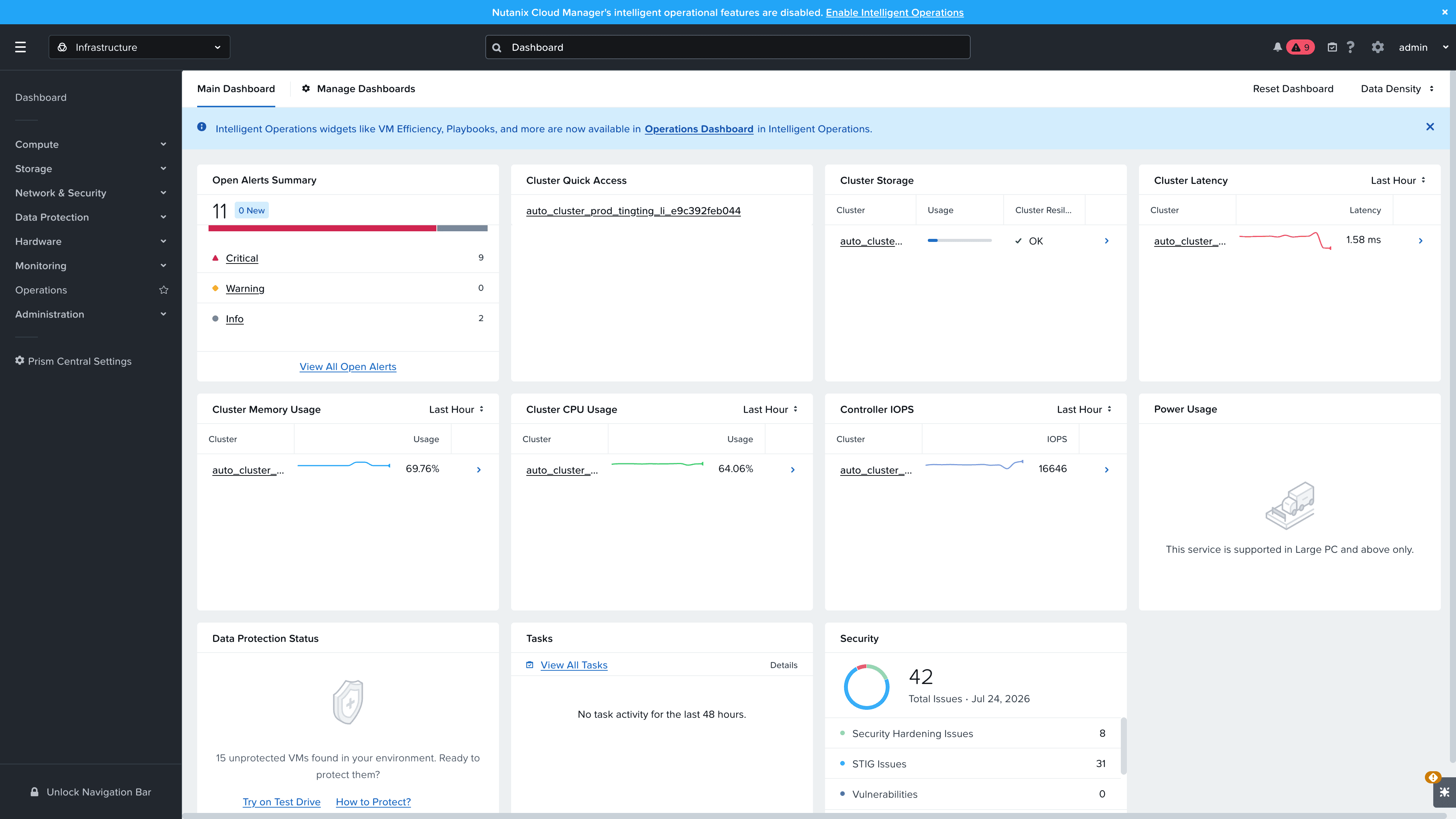
The existing Prism Central interface had accumulated significant usability issues over time. As the platform grew in scope, the UI became harder to navigate and inconsistent across features. Before we could introduce NIVA (Nutanix's AI-powered virtual assistant), we needed to groom the interface so that AI interaction paradigms could be integrated smoothly into the experience rather than bolted on as an afterthought.
The challenge was twofold: modernize and simplify the existing UI while simultaneously laying the groundwork for a fundamentally new way of interacting with cloud infrastructure through natural language and AI-assisted workflows.
Design
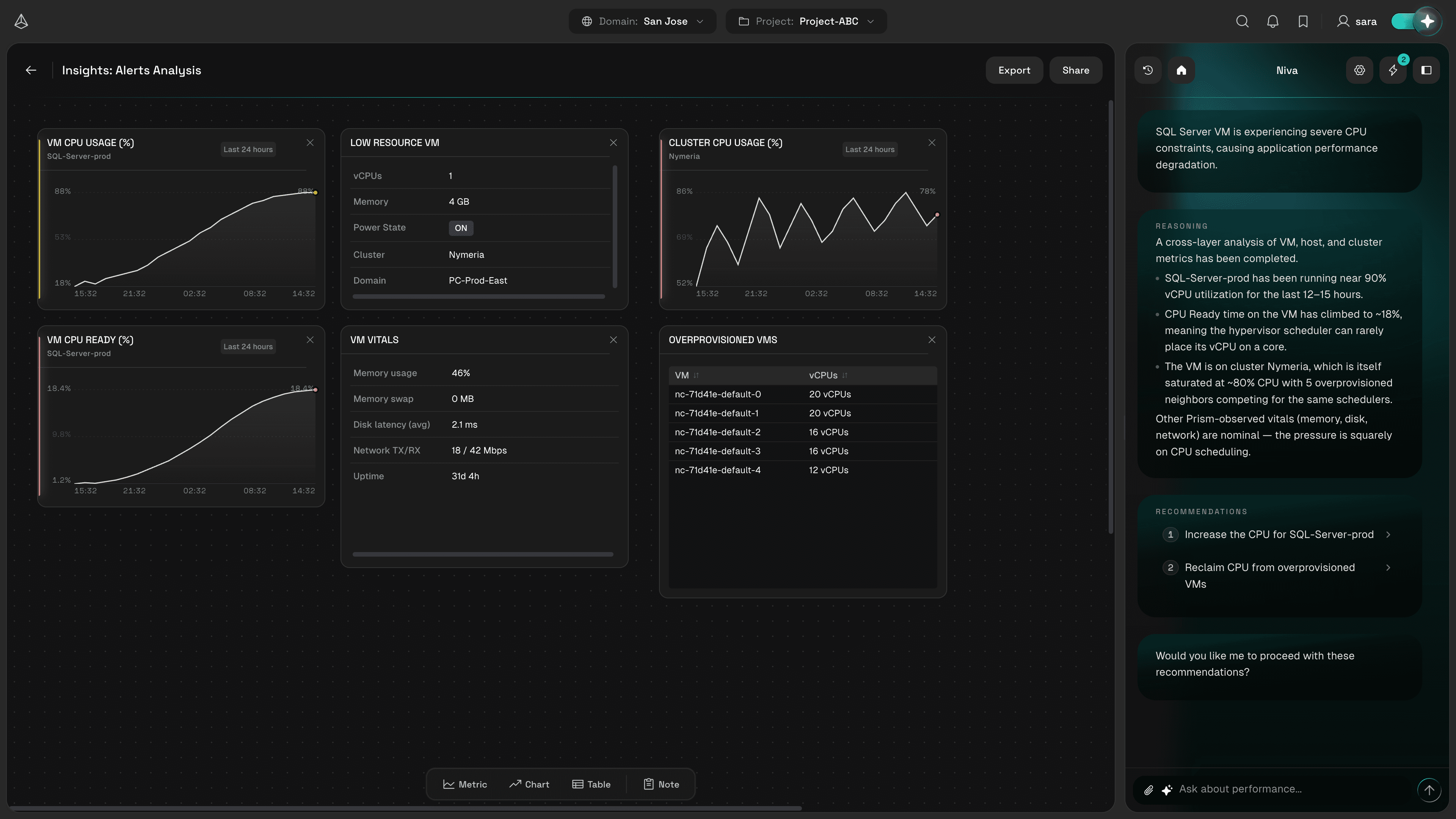
Rather than treating NIVA as a traditional chatbot sidebar, we designed a canvas-like AI interface that generates rich, interactive UI components rather than just returning plain text. When a user asks NIVA about cluster health or storage utilization, the response isn't a wall of text. It's a live chart, an actionable table, an entity card, or a configuration action rendered directly in the conversation.
The component vocabulary included:
- Charts: real-time visualizations of cluster metrics, storage trends, and performance data
- Tables: sortable, filterable views of VMs, hosts, and resources
- Entity cards: compact summaries of specific infrastructure objects with quick actions
- Actions: inline buttons and flows that let users take action directly from NIVA's response without navigating away
Each response type was designed to feel native to Prism Central. The canvas approach meant users could see their full conversation history with rich context intact, rather than losing it to a disposable chat thread.
Engineering
The entire UI was built in React. I designed and implemented the component system that NIVA's AI layer could dynamically compose, from the canvas layout and conversation rendering to each individual response type (charts, tables, entity cards, action panels).
The key engineering challenge was building a flexible rendering pipeline that could take structured data from the AI backend and map it to the right component with the right configuration, while keeping the interactions responsive and the state manageable across a complex conversation history.
Impact
The NIVA integration won Nutanix's internal hackathon, though that wasn't the primary objective. More importantly, the project was greenlit for the product roadmap and is now being developed as a core part of Prism Central's future experience.
Reflection
This project was a clear example of why the design engineer role matters. The AI canvas concept only worked because the person designing the interaction model was also the person building it. Ideas that would have been lost in a design-to-engineering handoff (like how the response components should animate in, or how the canvas should handle mixed content types) could be prototyped and refined in real-time.
The biggest lesson was that AI interfaces need to be designed around the output, not the input. Most AI UX focuses on the prompt experience. We focused on making the responses genuinely useful, and that meant treating each response as a first-class UI surface, not an afterthought.